Friday, June 21, 2013

City of Gold, Part II


I said in my last blog that Dawson seemed a lot less hokey than Tombstone, Arizona, another legendary town from about the same time period and with a similar boom-bust mining heritage.  I couldn’t quite put my finger on the reason. Now I have it.  We felt we were missing something, so we stayed an extra couple of days to try to find it.  “It” was right at the visitor center.  We’d just missed it earlier.

We happened by about 8 pm, just as a walking tour of town was starting out in the bright sunshine.  So we joined in.  The 90-minute tour was billed as “Strange Things Done in the Midnight Sun,” in reference to a poem by Robert Service.  A young man in Victorian costume led it.  He was a hoot. 


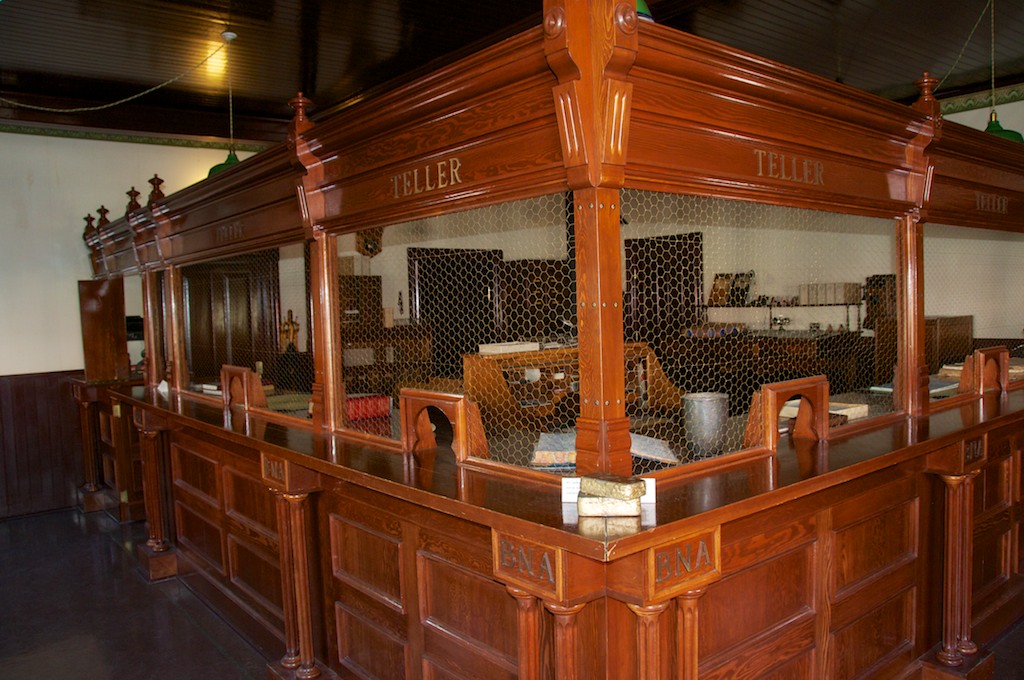
It turns out that many of the buildings from Gold Rush Dawson were falling apart by the 50s.  So was Dawson. It had fallen upon hard times as mining slowed.  The Canadian parks service, Parks Canada, bought and preserved more than 40 of them. I had wondered earlier how Dawson could support a daily newspaper.  Turns out what appeared to be a paper was one of the historic buildings preserved, equipment and all.  “The great thing about Dawson is how far it was from anyplace else,” out guide explained.  So when a business failed, the owner couldn’t afford to ship it south and both buildings, furnishings and equipment were abandoned where they stood.  And got preserved by Parks Canada,


Our guide took us to the Post Office, the Dawson Daily News, Bank of British Canada, Billy Biggs Blacksmith shop and the restored bar at the Red Feather Saloon.  And told us stories about the times.


Parks Canada has staffed Dawson with a cadre of enthusiastic interpreters who host visitors at the visitors center, take tours and even act in plays.  We went to one at the Palace Grand Theater, a structure that far outstrips Tombstone’s Bird Cage Theater in size and elegance.  The interpreters had the audience participate in their Greatest Klondiker contest to pick the most influential person of the period.  


Klondike Kate assigned judges, and even a timer, and then had interpreters playing three famous characters from the gold rush period argue why the honor should fall to them.  Theater owner Arizona Charlie Meadows, an English teacher/reporter whose name I missed, (but it sounded a lot like "Faith Hill") and Mountie Superintendent Sam Steele argued back and forth with the audience peppering them withe questioning.  Marsha got to be a judge.  Kate had an Applause-O-Meter on stage which she said was scientifically tuned to measure votes cast in the form of wolf howls from the audience. Steele got the most howls and a nice “Klondike” sash to go over his red coat.  Hmmmm.  The mountie looked a lot like our guide from the walking tour.  Then everybody went out to the lobby and visited while they took photos of us all with the cast.  And gave us prints on the spot.  Pretty neat.  Nothing like that in Tombstone.


We did another Parks Canada walk with a lady who really knew how to pan gold.  She’d done it for a living; testing out core samples being drilled at a claim to find the most likely places to mine.  She showed me how to shake the gold to the bottom of the pan while flipping out the rocks with water.  It was a lot harder than it looked and the water was cold.  She also explained how claims were, and are today, registered, how big they can be, etc.


Parks Canada isn’t alone in this effort.  The Dawson City Museum has terrific interpreters, too.  Two of them showed us how a rocker box was used to separate gold from gravel and sand on hillside claims where you don’t have unlimited water. 


They salted a bucket of sand and gravel with two real gold nuggets then sluiced away.  The rocker picked up both of them immediately.  Then they showed us how the gold got melted down into bars.  We got to hold a freshly melted ounce of gold worth about $1400. It was bigger than I expected.  It would take quite a few nuggets to make an ounce.  Darn.


 Next door the same nice young lady from the museum showed us their collection of antique locomotives and explained how they were used by the Klondike Railroad to haul ore down from Bonanza and Eldorado Creeks on narrow gauge tracks. Nothing ever went back south. The history stayed here.


Finally, we ended up at the Nugget jewelers, where Marsha and I bought matching wedding rings made of gold nuggets from local Klondike streams.  [Photo on that when I can pry it out of the internet]. 

Ok, so now I feel like we did Dawson. But it took five days to do it right.

In my next installment I promise to tell you about our trip across Top of the World Highway (whew!) and then our upcoming visit to the all-nighter (well, all dayer) Midnight Sun Festival in Fairbanks where they have music, food and vendors in an all-night event (there I go again) on the longest day of the year—24 hours of daylight.  Don’t try THAT at home.


John and Marsha


(All photos copyrighted 2013 by John B. Taylor)


Monday, June 17, 2013

Dawson and Klondike Gold


When the infamous Soapy Smith ruled Skagway, one of the many scams he used to separate the arriving gold stampeders from their money was his telegraph. He charged what would have been several months of a normal wage back home just to send one telegram from his “telegraph office,” where the wire ran no further than out the back door.  We suspect that Soapy is now running the Internet in the Yukon.  It doesn’t seem to work.

The “free” Internet at our Whitehorse campground turned out to be free because it worked only sporatically. Before leaving Whitehorse Friday we spent two hours at a Starbucks trying to send out a message telling you that we’d posted our Whitehorse blog the day before. It wouldn’t send.  We finally got away so late in the day that we made it no further than a roadside rest stop about 100 miles short of Dawson. 


The scenery continues to amaze.  This is the Five Fingers rapids (above), where paddle wheeler steamers had to fight their way upstream against a fast current caused by the narrows.  The only way they could get through was to use a cable from a cliff to winch themselves through the tiny gap on the far left, between the cliff ashore and the first island on the left.

We followed the Yukon River all day, and about 8 pm camped beside it and its primary mosquito herd.  We moved out early the next morning without ever having left the bus.  Morning is a relative term up here, where it gets dark sometime after 1:30 am and light again before 3 am. If it gets dark at all.  We stopped for breakfast about two miles down the road at the Moose Creek Lodge. 

Everyone there, staff, guests and owners, spoke German.  Guten Morgan!  We had a good breakfast and got away just ahead of the Holland America bus, which returned from a tour of something with a full load of, you guessed it, German tourists.  Or Swiss, maybe.

We hit Dawson about noon on Saturday and went right to the library, fearing it might close for the weekend.  It had Internet that worked!  I found that the message that wouldn’t send from Starbucks in Whitehorse must have sent itself some hours later.  Then, we went in search of a barbershop. 

A nice Italian-speaking woman cut my hair for about $30 and told me about the town.  It has somewhere around 2000 permanent residents and a bigger bunch of seasonal folks who get the heck out of town before winter hits.  Including her. Apparently, in the winter one night in town seems like it last forever.  Maybe because dawn comes in six months or so.

Dawson sits right on the Yukon River, where the Yukon comes together with a smaller river called the Klondike. The Klondike was in all the papers about 120 years ago when wealth beyond imagination was available on several of its smaller tributaries simply for the scoping. Provided you were lucky enough to file a claim while you still could get one.

My grandfather, Pop, wasn’t that lucky.  He arrived on the frozen river in the winter of 1897 driving a dog team.  He was too late before he even left home.  As were the other 60,000 stampeders who arrived at Skagway or Dyea after he did, and the 20,000 of them who actually made it to Dawson.


Or were they?

We have learned that people like Pop, who didn’t get to stake a claim of their own, earned an average of $150 a day working someone else’s claim.  To put that into perspective, a clerk or accountant in San Francisco earned $300 a year at that time. So Pop could have earned a whole year’s income every two days!  If he stashed his gold (the owners paid them daily by scooping up nuggets off the ground) he may have come home a very wealthy 20-year-old.

He always told me that when I was old enough, we’d come to Dawson together and “paint the town red.”  Sadly, he died when I was eight. Tomorrow I’m going to find a hardware store and check out paint swatches. I think it would look nice in a tomato red.


Marsha and I drove up the road along Bonanza Creek on Sunday, just on the south edge of town, and saw what happened since the boom of ‘97. Gold mining got mechanized, and huge dredges were brought in to dig the ground down to bedrock and rip the gold out by the ton.  The creek is still there, more or less, but dredges have chewed it all up in the years since the stampeders did the work by hand.  The claims are still active.  With gold running $1600 an ounce, there is a lot of activity on the creeks.


There is a free claim on the once fabulously rich Eldorado Creek. It is at a former town site where once 4000 people lived and worked until the dredges arrived.  It’s now owned by the visitor bureau and available to anyone to pan.  You get to keep anything you find.  We went equipped with a pan and hand pick.  It wasn’t enough. 


I dug up some dirt across the road and brought it back to the creek to pan out.  I found that while I could wash the dirt out pretty easily, there was so much small rock that didn’t wash out I panned the same load for an hour and wasn’t any further along.  After knee surgery I can’t squat in the stream, either.  And the banks of the stream were pretty steep, so I had no place I could easily perch a stool.  Hmmmm.  Ok, I need some instructions.  Maybe tomorrow I’ll find someone who can explain the process.  It is a lot harder than it sounds.

The big problem is that I can’t tell gold from mica or pyrite or any of the other glittering rocks on my pan. Everything here seems to sparkle. Including the dust in my pan that I keep washing away with each swirl of water. It is probably real gold dust, but I have no idea how to salvage it.

We did drive around a 60-mile loop to King Soloman’s Dome, which appears to be the source of all the gold found on creeks running down from it.  No one has ever found this "mother lode" but they keep looking.  The claims numbers went into the dozens as we topped the heights.


This (right) is an old roadhouse near the top of the dome.  Lower on we found this second roadhouse sitting on a claim (below right).


We stopped back in town of some supplies.  The local grocery has Borax on its shelves.  Imagine that.  I haven’t seen Borax since Ron Reagan quit selling it on TV in the fifties.  And it features one other very imaginative breakfast cereal you don’t see at home. My reaction was, well, Holy Crap!


We have been staying at the Klondike River Yukon Government campground about 10 miles east of town.  The commercial campgrounds here make Walmart parking lots look spacious. We have only a few neighbors and every night the rangers bring around free firewood.  But since the sun never sets here , sitting around a fire in broad daylight doesn't have much appeal.


The way back to the US from Dawson is via a ferry that runs across the Yukon.  It is amazing to watch as it pulls away from shore, gets swept downstream by the swift current, then fights its way back to the other shore.  There are no docks.  The ferry drops its ramp on the dirt and uses engine power to stay in place while you drive off.  That will be fun with the motorhome.

From there it is 67 miles to Alaska, across the Top Of The World Highway, said to run waaaayy up high along a long ridge.  It’s unpaved.  It may be an adventure.


Friday, June 14, 2013

Whitehorse, Yukon's Capital

We spent three days in Whitehorse visiting the cultural hotspots like Walmart, Canadian Tire, the library (wifi) and, and, and...  

What you may not know is that I am the second member of my family ever to visit Whitehorse.    Marsha and I are in a motorhome; my grandfather, John E. Badley, for whom I was named, came through in the winter of 1897-1898 mushing a dogsled team on his way to the gold rush in Dawson.

Because this is the capital of what is now called "Yukon" (instead of "Yukon Territory," or even "The Yukon") it hosts the Yukon Archives.  There we spend a couple of afternoons trying to find some trace of the incredible man I always called, "Pop."


Pop was about 19 years old when he landed in Skagway's neighboring town Dyea, and packed the Chilkoot Trail to the high Chilkoot pass. You've probably seen photos of that.  Amazing pictures show lines of ant-like men climbing steps carved in ice for six hours with heavy packs to get to the top of the pass.  By then Pop had already made the pilgrimage by wagon train from Kansas to the Oregon Territory; prospected in Arizona, Colorado and Montana, and had even driven a stagecoach between Silver City,  Deming and Lordsburg New Mexico,.  This, by the way, was the same route John Wayne took in his first John Ford western movie, Stagecoach. 

Pop was one of 60,000 people, mostly Americans, who came north for the big gold rush.  He was one of only 20,000 to make it all the way across the frozen countryside to Dawson.  By then, the good claims were pretty much all taken.

We knew Pop had gone to the Philippines in 1900 to fight a bunch of Muslim fanatics trying to wrestle control of the country from the US, which had won it in a recent war with the Spanish. So he must have arrived here in the fall of 1897 or winter of 1898.  Alas, we hit the archives when their regular staff was off somewhere, but some very nice researchers tried very hard to help us. We found zip.  But the good records really didn't start until 1899 when the Mounties put a scale atop the pass and demanded you place about 1100 lbs of supplies on it before they would let you enter Canada.  More on that when we get to Skagway in a month or so.


Whitehorse is a nice little town on the Yukon River.  It is civilized, meaning it has two Starbucks stores. And some nice eateries.


We found that MacDonalds charges $10 for a Big Mac meal, so paying $20 for some really good Halibut fish and chips at the Klondike Rib and Salmon Barbeque eatery didn't seem out of line. Stuff costs up here.  


Our waitress (can you still say that?) had a badge proclaiming her to be "Taylor." I asked her if that was a first or last name and she explained that when she was born she had some terrible problem. Her father saved her life by flying her to a hospital in his TaylorCraft airplane.  So she was named for the plane.  She was delighted to find I knew what a TaylorCraft was. How great to have a story like that to go with your name. 


We also visited the SS Klondike, a paddlewheel steamer built in 1937 to haul ore and ferry supplies up and down the Yukon River.  The Yukon River, by the way, has its origins about 13 miles from the ocean at Skagway, but it takes over 2000 miles for it to reach the Bering Sea near Nome.


This ship provides a good example of how the river drove all forms of business and life in the Yukon. The Klondike paddlewheeler would work all summer to move cargo, ore and people up and down the river.  It then got pulled up on the shore for the long winter while the river was frozen solid. It sank after having its hull holed at one point, but was rebuilt by putting its entire superstructure onto a new hull.


This gives you a look at Whitehorse today.  Some old buildings and new ones.  The river still runs through it. But the rapids that killed 300 would-be miners is now under a lake.
The train from Skagway came here in 1899, so late-coming miners heading for Dawson could avoid the dreaded Chilcoot and White  Passes and take a train directly to Whitehorse where they could board a steamer to Dawson. This is what made Whitehorse a city.  It became a  transportation hub.


I thought this view offered an interesting perspective of the old and the new in Whitehorse.


This is Whitehorse viewed from across the river just above the hospital.


Ok, so I notice odd stuff.  You can tell a vehicle owned by a resident from one owned by a visitor by the telltale cord hanging out the front of the grille (above right).  These cords allow you to plug your car in at night to keep the engine from freezing.  The Yukon license plates (right) are a clue as well. They feature a gold panner.  So, here is a Canadian license plate with a picture of an American panning gold in their country. Pretty amazing that they even let us in.


I don't normally stand in front of a landing airplane.  But at the airport  here they have this DC-3 on a pole.  It has over 30,000 flying hours, which is a lot.  It is a former airliner, and a military Dakota from WWII, and it now serves as a----get this---- weather vane.  Put this on your barn, I dare you!


This is where we started out. At Walmart with a whole bunch of other people.  Including a guy operating a taxi service from an RV parked next to us in the Walmart lot!  He ran his generator all night and cranked up one of his two taxies at all hours whenever he got called to make a run. We left the next morning.


We moved to this RV park south of town.  It was much nicer. Set in the trees with no close neighbors. We even built a fire one night. The only problem was their wifi kept quitting, so I'm send this from a Starbucks right back next to Walmart.


It is now Friday and we are moving on to who knows where. Dawson is more than 300 miles and 8 hours north, NOT on the Alaska Highway, so we may stop in Stewart Landing.  Or Carmack.  You probably won't hear from us again till we reach Dawson and find a library with WIFI.

In the immortal words of Johnny Horton, "North to Alaska, goin' north the rush is on."  If not Horton, I'm sure it was somebody.

John and Marsha